
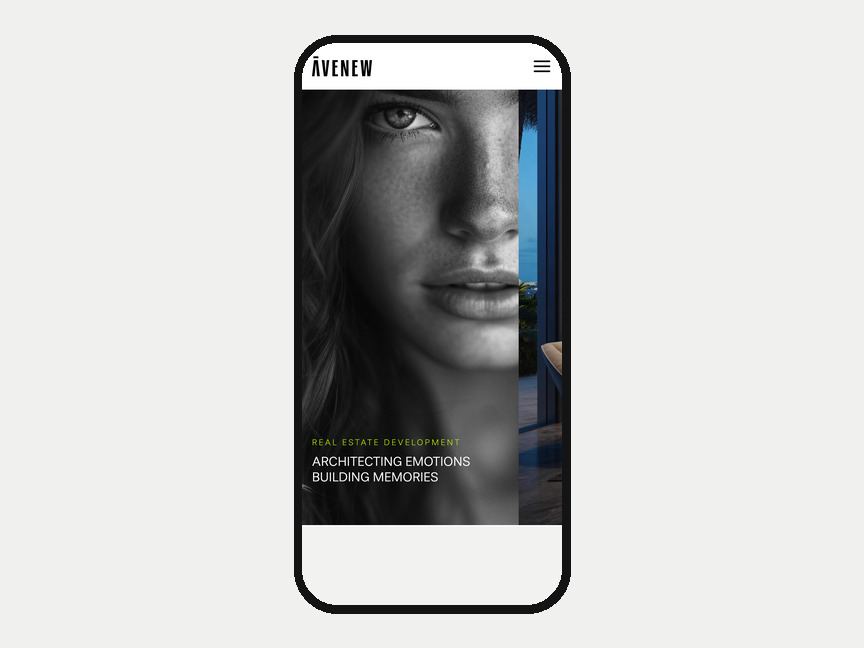
Real estate in Dubai is sold from a plan. A buyer meets a project on its website, its hoarding and its brochure long before they see a finished room, which means real estate website design carries more of the sale than it seems to. This note sets out what a developer's or a brokerage's site has to hold, and how the website, the brochure and the hoarding can describe the same place.
A developer site and a brokerage site do different jobs
They sell different things, so they need different sites.
| Developer | Brokerage | |
|---|---|---|
| What it sells | Its own projects, sometimes under a master brand | Other people's projects |
| What the home page leads with | The current project and the idea of the place | Search and the latest listings |
| The page that matters most | The project page | The listing page |
| What has to stay recognisable | The project brand | The brokerage's own name, on every listing |
A developer's site is closer to a campaign. A brokerage's site is closer to a catalogue, and its brand has to survive being repeated across every listing.
The project page
For a developer, the project page is where a buyer decides whether to book a viewing. It needs to hold the idea of the place, the location, the plans, the brochure download and the enquiry, in roughly that order.
The idea comes first because it is what the buyer will repeat to their family. The location and the plans follow because they are what the buyer checks next. The brochure download and the enquiry come last, and they should never be more than a thumb's reach away on a phone.
Listings that stay on brand
A brokerage adds listings all the time, often made by different people. Without a template each one drifts a little, and the site starts to look like a noticeboard.
Listing templates fix that. The layout, the type, the photo ratios and the details shown are set once, so every listing looks like it came from the same company, whoever made it.
The site, the brochure and the hoarding describe the same place
A real estate brand works at two distances. On the hoarding and the signage it is read from a moving car, so the mark, the name and the colour have to carry at that scale. In the brochure and the sales gallery it is read up close, by someone about to sign.
The website sits between the two. It should use the same idea, the same words and the same pictures as the hoarding and the brochure, so a buyer who sees the plot on the way to work recognises it again on their phone that evening.
Designed for the phone and the desktop: AveNew Development
AveNew Development, a property developer in Dubai, is a case of one decision carried through: an editorial site with the type in black on white and lime as the one accent, taken from the Ā in the logo. We designed it for the phone and the desktop together, so neither is an afterthought.
The enquiry
The enquiry is the point of the site, so it should use the channel the buyer already uses. For some buyers that is a form or a brochure download; for others it is a message.
On another site of ours, for Bedaya Polyclinic in Dubai, every inner page closes on a WhatsApp message, the clinic's first channel. The sector is different; the principle carries over. Who answers and how fast is the developer's process, and the site should promise only what the sales team can keep.
Search starts with the site map
Real estate website design and search are planned together, not one after the other. Each page gets one search phrase. Project pages carry the project's name, because that is what buyers type once they have heard of it. The copy and the search work are written in the same pass, so the words that rank are also the words that sell.
That is how we planned the Bedaya Polyclinic site, from the strategy to the build, and it applies to a developer's site in the same way.
One site, or one per project?
For a developer the brand is usually either a project brand or a master brand that several projects sit under, and the website follows that choice.
A master site with a page per project means each launch builds on one address that search engines already know, and a buyer who liked one project finds the next. A separate site makes sense when the project is sold as a brand of its own, with its own name on the hoarding. Either way, the project page holds the same things, and the enquiry goes to the same team.
How a real estate website runs with us
The fee is set by the scope: the number of projects and page types, whether there are listings, the languages and the imagery. We quote after a short call, once those are known.
A real estate project with us starts with one conversation about the plot or the portfolio, the buyer, the launch date and what has to be ready for it. Read more about our real estate web design in Dubai.