
Restaurant branding starts with an idea, not a logo. Below are three restaurant branding examples from our studio in Dubai, each told through the idea that shaped it: Lento, an all-day restaurant in Addis Ababa; The Meal Plant; and the menu for the Reel Platinum Suites at The Dubai Mall. In each one the idea came first and the pieces followed. Where a picture is a render or a mock-up rather than a photograph, the case page says so, and so do we.
Lento: a restaurant built around the hour
The idea came first
Every restaurant sells food and rents time. Lento sells the hour itself.
That sentence was settled before any artwork was drawn, and every later choice was checked against it. An all-day restaurant meets the same guest at different hours: a coffee in the morning, a long lunch, a table after dark. An idea about time gives all of those visits one reason to exist.
The line the client approved says it in four words: *The hour is yours.*
What the idea decided
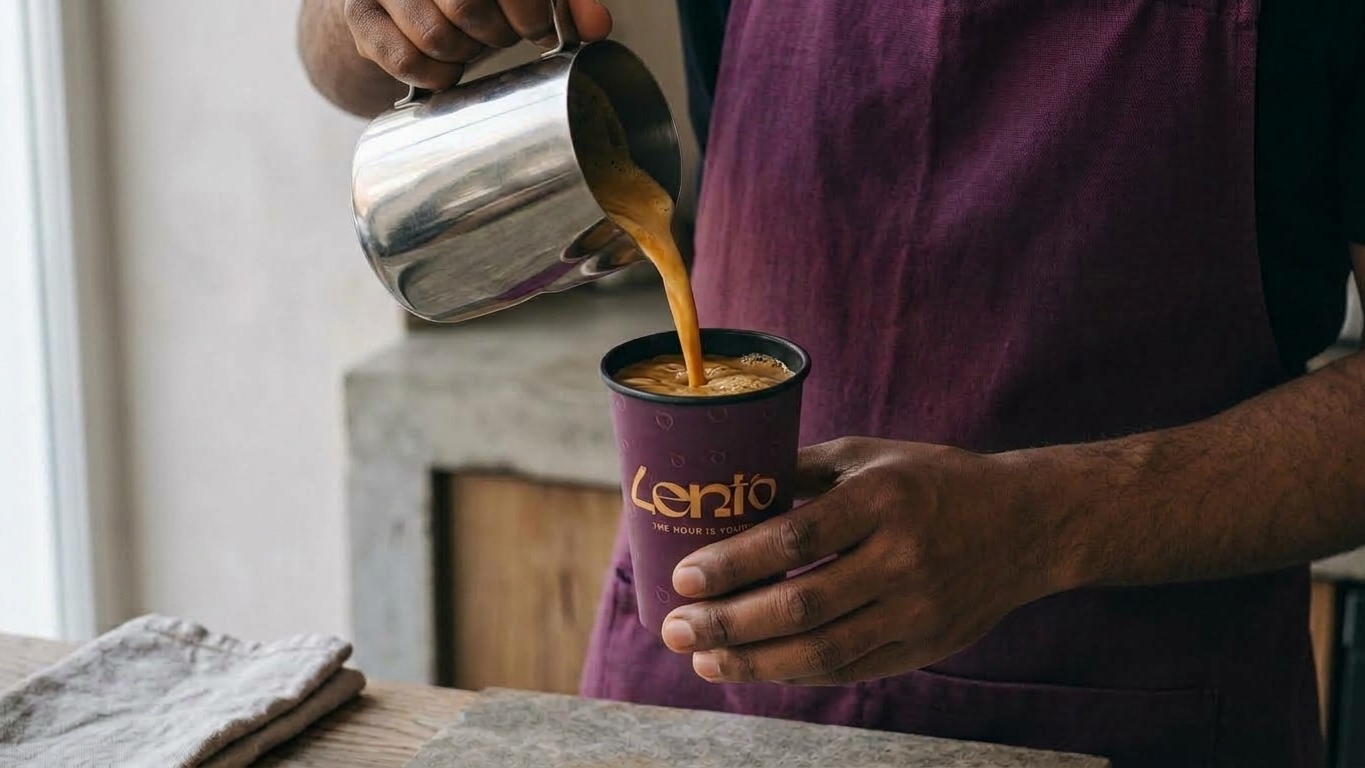
Once the idea was fixed, the choices became easier to make and easier to refuse. The name is built from its own o, with a tick that reads as the time. The colours are aubergine and mustard on cream. The line travels on the menu, the cup and the bag, so a guest who takes something home takes the idea with them.
The room follows the same rule. Mustard appears on the sign letters and nowhere else in the fit-out, and the pattern goes on the things that move rather than on the walls. The rooms on the case page are renders from the architect's plan, not photographs.
The Meal Plant: one star, grown into a pattern
The Meal Plant's identity grows from a single shape. The icon is a planter whose cuts draw a tree. The pattern takes a five-point star and repeats it outwards in rings of lilac and green.
That is the whole system. One shape does the work, so the brand stays recognisable at the size of a sticker and at the size of a shopfront. The applications on the case page are our presentation mock-ups.
Reel Platinum Suites: a menu read by lamplight
In the Reel Platinum Suites at The Dubai Mall, food is cooked to order and brought to the seat. The guest reads the menu in a dim room, by the light of a table lamp, in English or Arabic.
That condition is the brief. The menu is the piece of a restaurant brand a guest holds longest, so we redesigned it for the room it lives in and produced it for Reel Cinemas. The case page shows the printed menu relit against renders of a suite.
See the Reel Platinum Suites case
What the three have in common
These restaurant branding examples look nothing alike, yet they share four habits:
- One idea comes before any artwork.
- The menu gets as much care as the logo, because it is the piece a guest holds longest.
- Every piece is designed for the print run it will actually get, so what is approved is what arrives.
- One list feeds the printed menu and the menu on the phone, so the two never drift apart.
How to find the idea for a restaurant brand
Start with what the guest buys besides the food. It might be time, as at Lento. It might be a ritual, a neighbourhood or a way of being looked after. Write it as one sentence a waiter could repeat.
Then test it against three things: the menu, the room and the bag. If the sentence tells you what to do with each of them, it is an idea. If it only describes a mood, keep going.
Last, use it to say no. A good idea for a restaurant brand rules things out: a colour, a typeface, a promotion that would muddy it. A brand that accepts everything ends up looking like five places at once.
Questions restaurant owners ask
What does restaurant branding include? The identity (the name if one is needed, the mark, the colours and the type), the menu for print and for the phone, the packaging, the signage and the direction for the interior, the website, the photography and film for the feed, and the guidelines that hold them together. Not every restaurant needs every piece on the first day. The opening date usually decides the order the pieces are made in.
Should a QR menu be a PDF? We'd rather it wasn't. A PDF behind a QR code asks the guest to pinch and scroll a printer's page on a phone. When one list feeds both the printed menu and a menu page built for the screen, the two stay the same, and a price changed in one place changes everywhere.
Working with us on a restaurant brand
In Dubai a guest usually chooses a table on a phone, so the feed and the menu page do part of the selling before anyone walks in. The same idea has to carry from the screen to the fascia, the menu and the bag. That is the work we do for cafés, restaurants and the groups that run several of them.
A restaurant project with us starts with one conversation about the place: the room, the menu, the guest and the opening date. Read more about our restaurant branding in Dubai.